CONNECT Newsletter
July 2026 Issue: 1 Year Anniversary!
|
Hello!
Welcome to the third edition of the CONNECT Newsletter! As we have just passed the one year anniversary of our partnership, we would like to share some exciting developments from our working groups, accomplishments, updates, and upcoming events.
Thank you for your interest in our partnership and for helping us work towards a more connected future for Big Team Social Science! |
- Important News
- BiTS Lab Updates
- Working Group Updates
- Highlighted Works from Partners
- Upcoming Projects
- Upcoming Events
|
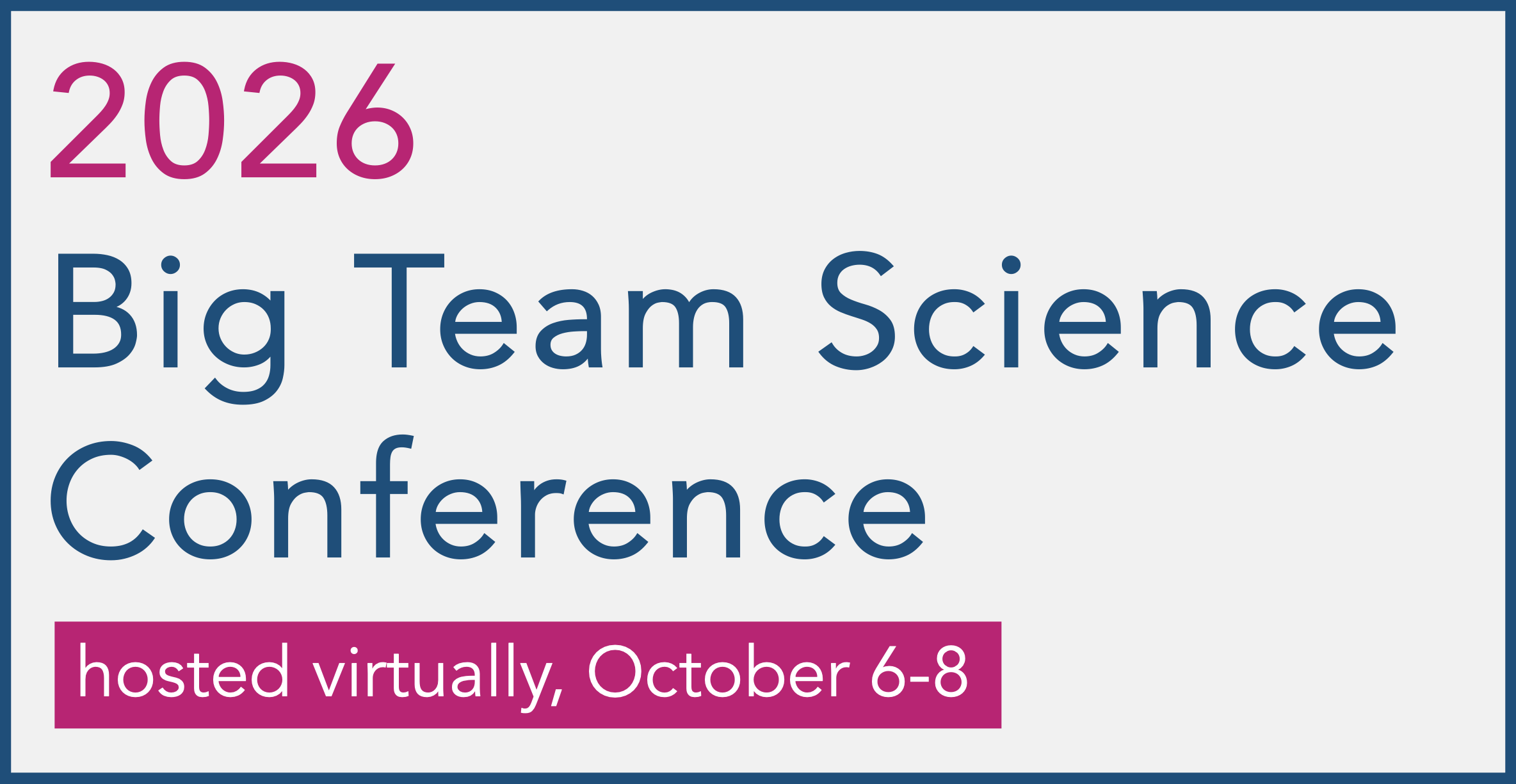
Abstract Submissions are currently open, and are due by July 24th. All work related to big teams/open science is welcome! |
|
|
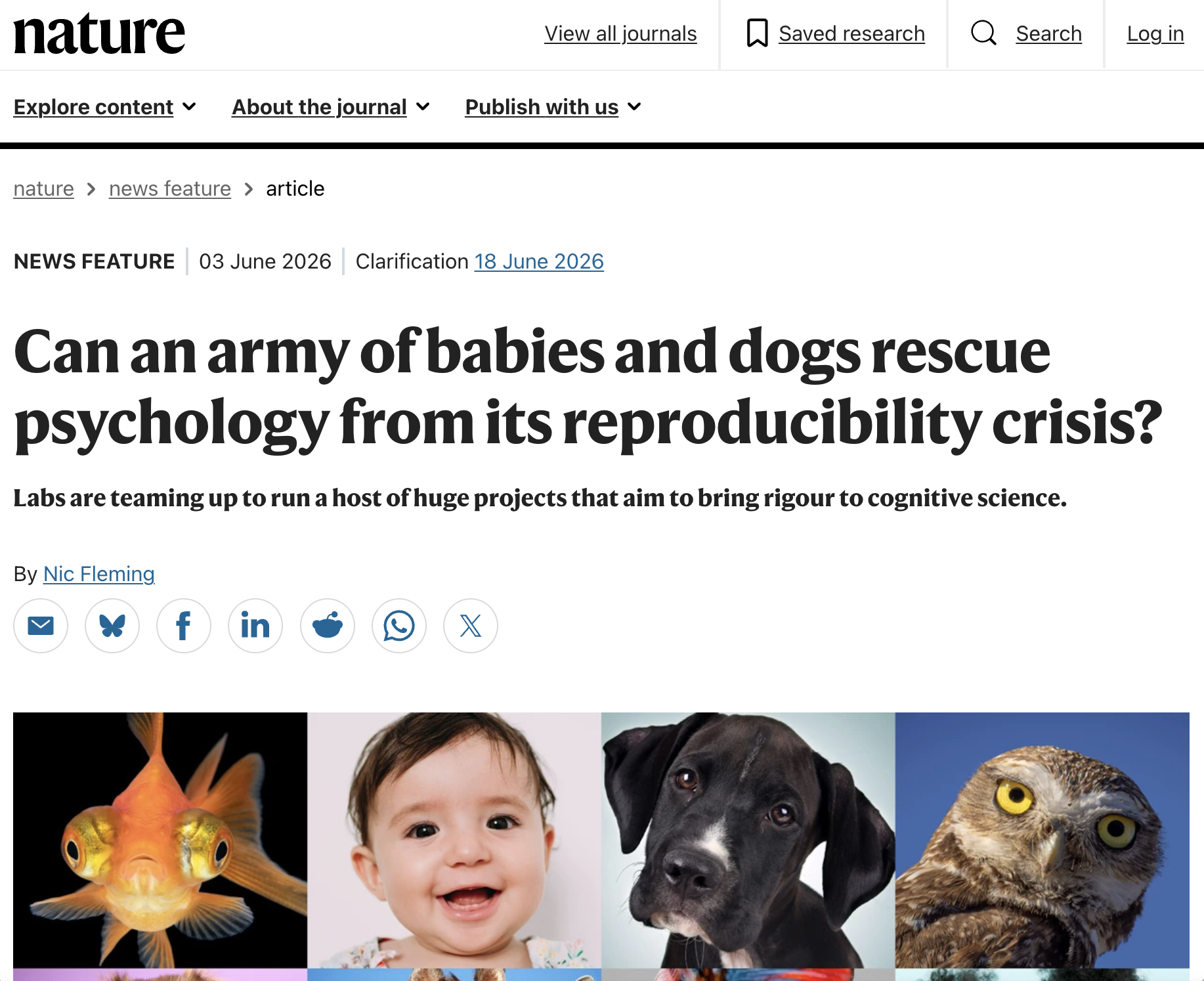
Check out this news article from Nature about Big Team Science featuring many of our network partners! |
|
|
|
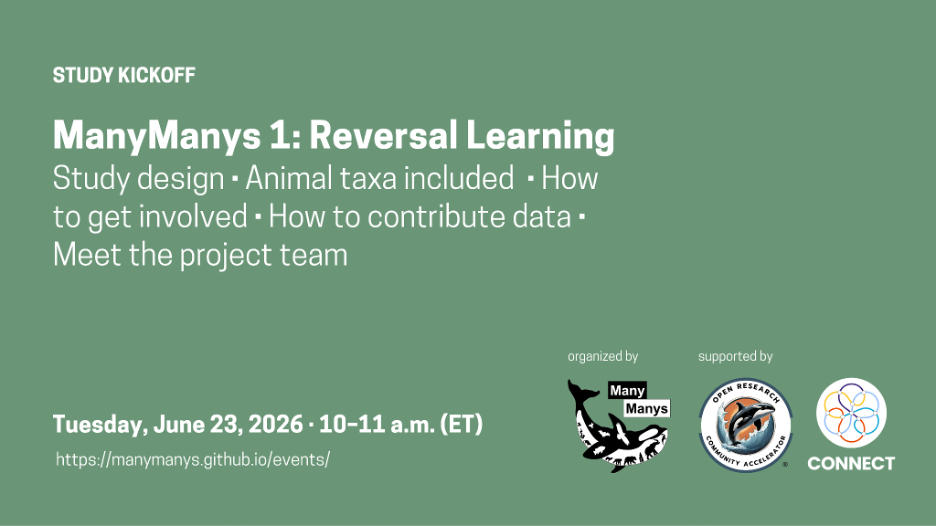
The ManyManys 1 Study Kickoff, held online on June 23, introduced researchers from around the world to ManyManys 1, the consortium’s first large-scale study on behavioral flexibility across animal taxa.
MM1 applies a reversal learning paradigm with three experimental conditions based on location, shape, and color. In each condition, subjects first learn to associate a cue with a reward. Once they have reached a predefined learning criterion, reward contingencies are reversed, requiring subjects to inhibit the previously rewarded response and learn the new association.
During the open event, project leads and members of the design subteam presented the study background and protocol, explained how laboratories can contribute data, and highlighted opportunities for collaboration and authorship. Researchers interested in joining this global initiative are encouraged to become contributing sites as data collection will begin soon!
To learn more about MM1, watch the recording of the public kickoff event here!
To access the MM1 Lab Manual, which contains everything needed to participate in the study, visit this page.
|
In the past year, CONNECT hosted 4 virtual BiTS Lab meetings!
The BiTS Lab is our central hub for facilitating partner exchange to inform and implement findings from our metascientific research activities. Every 3 months, our network representatives come together to identify common challenges, test solutions, and formulate plans for developing novel tools where none are currently available.
In particular, our February meeting focused on the topic of Barriers, Successes/Failures, and Strategies for BTS Funding. It has since led to the development of a collaborative paper aiming to examine the extent to which current research funding structures align with the realities of international, distributed BTS networks. The goal of this paper is to provide an evidence-based foundation for rethinking funding policies and for designing new grant mechanisms better suited to large-scale, inclusive, and open collaborative science.
|
|
|
CONNECT is supported by three specialized working groups that drive our core initiatives. Here is what the groups have been working on this past year. |
The Metascience Working Group conducts metascientific research to understand current processes and workflows in existing Big Team Science (BTS) networks.
|
|
|
In year 1, the group designed a Big Team Science (BTS) Experience Survey to assess the experiences and perceptions of researchers and trainees who are directly involved in Big Team Science projects!
BTS remains largely understudied despite its rapid growth, thus this systematic data on how BTS works in practice is crucial information for articulating the value of BTS to those who are unfamiliar with it (e.g., funders and evaluation committees), and for improving the experience of BTS collaborators as well.
We are happy to say that we have just wrapped up the data collection stage, and are now moving on to data analyses. Our aim is to use our findings to help improve the experience of BTS collaborators by making collaborative science more reliable, inclusive, and impactful. |
|
|
The Tools and Infrastructure Working Group translates research insights into practical solutions by designing, implementing, and refining tools and infrastructure to enhance BTSS efficiency. In year 1, we focused our efforts on the development of BTS Tools.
|
|
|
First, the group has been testing and refining an open source data validator app being developed by co-lead Francis Yuen. Early BTSS projects across networks reported inconsistent data reporting (e.g., reporting duration in seconds vs. milliseconds) as a common data processing issue, which resulted in massive bottlenecks in the form of laborious hand-checking to correct discrepancies. The ShinyValidator is designed to be a user-friendly, customizable, web application for facilitating harmonization of tabular data, with key features like automated detection of data standard violations. Now, in the testing stage, we are moving closer to our goal to make a user-friendly editable version publicly available.
Next, the group conducted a survey assessing the prevalence of existing project management tool use in BTS research, and researchers' familiarity with and attitudes towards these tools. When it comes to BTS researchers’ preferred features, they reported a desire for ease of use, customizability, and interoperability. Two primary concerns that were raised about existing tools were regarding cost, with some tools being prohibitively expensive or having features locked behind paywalls; and regarding data storage and safety, with many respondents expressing concern about relying on mega-corporations like Microsoft and Google. With these findings, we are looking to create more user-friendly guides for already existing, free and open source tools to address some of the primary concerns that were raised.
Now that we are in the second year of our partnership, we are looking into the infrastructure side of Big Team Science project management and thinking about what resources researchers can use to organize and coordinate large-scale collaborations. |
|
|
Equity, Diversity, & Inclusion |
The EDI Working Group promotes inclusivity across all aspects of BTSS, development of EDI strategies tailored to BTSS challenges, and creation of inclusive meeting practices that address barriers like time zone differences and language accessibility. |
|
|
We are excited to share that we have put out a call for abstracts for an EDI special issue in collaboration with the Avances en Psicología Latinoamericana (APL) journal, tilted: Advancing Justice, Equity, Diversity, and Inclusion (JEDI) in Big Team Social Science!
We are inviting various submission types in psychological research pertaining to JEDI in Big Team Science, covering topics such as governance, project management, authorship and credit sharing, networking, funding applications and management, language and time zone barriers to participation, epistemic decision-making, the value of time and other forms of invisible labor, Majority/Minority World researchers, race/ethnicity, gender, and disability, etc.. Importantly, submitted articles may be written in any of Spanish, Portuguese, or English.
Abstract proposal deadlines are due July 31st, so please share this call widely! More submission details can be found on the journal’s official website. |
|
|
Highlighted Works from Partners |
ManyDogs
The ManyDogs1 project examines human-dog social interaction, specifically regarding dogs’ understanding of common human gestures. Please see the ManyDogs newsletter for a brief summary of their findings. |
|
|
ManyFishes
The ManyFishes1 project is a large-scale collaborative study that investigates inhibitory control across the fish taxon. Please see a student poster, “Do parrotfish pass the cylinder task?”, here! |
|
|
ManyManys
The ManyManys 1 Study Kickoff, held online on June 23, introduced researchers from around the world to ManyManys 1, the consortium’s first large-scale study on behavioral flexibility across animal taxa.
To learn more about MM1, watch the recording of the public kickoff event here.
To access the MM1 Lab Manual, which contains everything needed to participate in the study, visit this page. |
|
|
Strengthening Democracy Challenge
The Structural Democratic Reforms Project brings together academics, practitioners, and others with relevant expertise in a collective effort to identify reforms that can strengthen or safeguard key elements of American democracy. The project has completed its first stage, collecting 884 proposed reforms to U.S. systems of voting, representation, legislation, and governance from 319 unique submitters. The project is now in its expert evaluation stage, in which field experts are assessing the full set of ideas to help identify the most promising, viable, and broadly supported reforms. Read more about the project here. |
|
|
Canadian Reproducibility Network
The call for papers is up for Canadian Metaresearch Data Challenge at the 2nd Canadian Open Science Conference, which has been scheduled for October 27-29, 2026. This challenge asks participants to develop an approach for mapping the Canadian metaresearch landscape in a way that is open, reproducible, and inclusive of diverse research traditions and methodological approaches. Please see more information on their official page here! |
|
|
The Center for Open Science
The Center for Open Science has created a large-scale research initiative known as SCORE (Systemizing Confidence in Open Research and Evidence), which designs tools to evaluate the credibility of scientific claims. Although SCORE is not a part of the CONNECT partnership, we wish to highlight their like-minded work.
COS is offering FREE Open Science training opportunities to members of the CONNECT partnership! First, is an asynchronous course on “Open Scholarship Training for Researchers”. To sign up, please fill out this interest form. Second, is a series of intensive “Live, Virtual Open Scholarship Training for Researchers”, which will take place this Fall. If you are interested in participating, please also fill out the form to indicate your preferences in terms of modules, location, timing, etc. |
|
|
Resource Curation Project |
In the past year, members of our network have been gathering resources related to Big Team Science and/or Open Science. As part of this project, we have designed a series of webpages that present these resources in an interactive and user-friendly format on the CONNECT website. The purpose of this project is to mobilize BTS and/or OS related knowledge in ways that are free and tailored to different skill levels. If you would like to suggest any additional resources, please submit these using our resource form!
|
|
|
Big Team Science Conference |
Register now and submit an abstract by July 24. All CONNECT partners are strongly encouraged to submit at least one abstract! |
|
|
Canadian Reproducibility Network presents: |
2nd Canadian Open Science Conference |
The call for papers is up for Canadian Metaresearch Data Challenge at the 2nd Canadian Open Science Conference, which has been scheduled for October 27-29, 2026. This challenge asks participants to develop an approach for mapping the Canadian metaresearch landscape in a way that is open, reproducible, and inclusive of diverse research traditions and methodological approaches. Please see more information on their official page here! |
|
|
Connect with us on LinkedIn
Here's an example post from the Psychological Science Accelerator (PSA) sharing their involvement with CONNECT on LinkedIn. Please repost or share your own experience! |
|
|
Help us track CONNECT deliverables (e.g., events, publications, tools) using THIS FORM |
|
|
|
|
|
|