Managing Global Teams
Time Zones
Big Team Science (BTS) encourages large-scale collaboration amongst individuals from various countries and regions. This requires the management of many different time zones. Within BTS, establishing an equitable approach to managing these times zones has proven to be logistically challenging.
Resources
-
Time Zone Cheat Sheet
This guide provides a range of suggestions and resources meant to minimize the impact of time zones on BTS projects. - The Advantage of Big Team Science: Lessons Learned From Cognitive Science (Vaidis et al., 2026)
Collaborative Writing
Writing in Big Team Science is a collaborative process that brings together researchers with different expertise. Clear communication, defined roles, and shared writing workflows help teams coordinate contributions, manage feedback, and develop high-quality manuscripts.
Publishing
What is the Process for Publishing?
Publishing provides researchers with an opportunity to share their work with the broader scientific community. In BTS, publications allow researchers to represent collaborative efforts and communicate large-scale findings.
Resources
-
What Defines BTS?
(Preprint)
Examines BTS publications, including article content and author characteristics. - Publishing in a Scholarly Journal (American Psychological Association)
- Flowchart of Publication Process
- Preparing Manuscripts for Publication in Psychology Journals
- Open Access Publishing vs. Traditional Publishing
Authorship
Authorship in Big Team Science (BTS) recognizes the contributions of researchers working collaboratively on large-scale, multi-institutional projects. Clear documentation of individual roles and the use of contributor taxonomies (e.g., CRediT) help ensure fairness, accountability, and appropriate recognition for all team members.
Resources
- CRediT Taxonomy
Contributor Roles Taxonomy used to identify and report individual contributions to scholarly work. -
CRediT Reporting Example
Example demonstrating how contribution reporting can be implemented. - Contributor Tables (Tenzing)
How do you Preregister a Study?
Preregistering is a way for researchers to communicate and register their research plans, before collecting their data. By doing this, researchers exercise the transparency required of open science, while increasing the credibility of their future findings.
Resources
- What is Preregistration?
- Preregistering a Study or Research Project
- Webinar: Preregistration Standards for Psychology
-
 ▶
▶
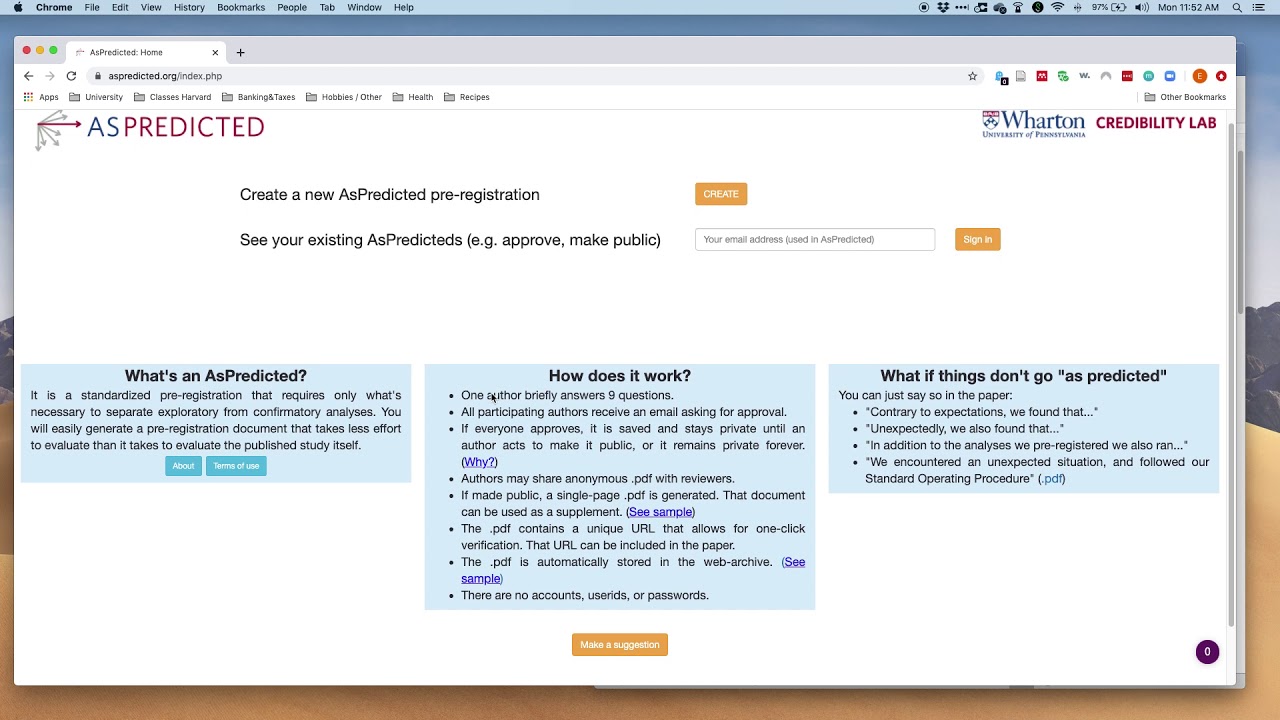
How to Preregister a Study on AsPredicted
Learn how to create a study preregistration using AsPredicted platform, a simple tool designed to help researchers document their hypothesis, methods, and analysis plans before data collection.
How can we Integrate OS into Ongoing Projects?
Explore practical ways to incorporate Open Science practices into existing research workflows, from planning and data management to documentation, sharing, and collaboration. Learn how small, sustainable changes can improve transparency, reproducibility, and the overall impact of your work.
Barriers
Conducting BTS or implementing OS is not always straightforward across collaborators. Below we have highlighted sources that discuss challenges researchers have faced and how to mitigate them.
What are some challenges with conducting Open Science?
Explore some of the common challenges researchers face when adopting OS, including cultural, technical, institutional, and resource-related barriers.
Resources
- Uncovering the challenges of OS
Take a deeper look at the practical and systematic obstacles that can limit the adoption of OS. This article examines real-world experiences and highlights opportunities for improving accessibility, collaboration, and transparency.
Authorship
Examine how authorship is assigned, recognized, and communicated in collaborative research. Discussions include the evolving expectations around credit, contribution, and accountability in OS.
Resources
- Recognition in Numbers: Can authorship norms in large research teams help reform research assessment practices?
Investigate how authorship models in large collaborative projects challenge traditional approaches to research evaluation. Explore whether new methods of recognizing contributions can lead to fairer and inclusive practices. -
What are some solutions for reducing barriers to Open Science?
Below discover practical strategies for overcoming obstacles to OS adoption. Learn about policies, tools, training, and community initiatives that support more open, equitable, and sustained research practices.
Resources
- How to overcome the Challenges on Open Science and Open Access
Implementing OS practices is not always easy. Researchers may face technical, financial, and cultural barriers that limit their participation. Gain insights into practical solutions that foster greater transparency and knowledge sharing. - A Perspective from the Global South Regarding Overcoming Challenges to Open Research Practices
Consider how regional contexts shape the adoption of OS practices. This resource highlights perspectives from the Global South, emphasizing equitable participation, local priorities, and strategies for addressing barriers in the global research ecosystem.
Illusion of Generalizability
Research findings may appear broadly applicable but may not always generalize across populations, settings, or contexts. Discuss the importance of diversity, replication, and thoughtful study design in producing robust and reliable evidence.
Resources
- Big-Team Science does not Guarantee Generalizability
Large-scale collaborations can improve statistical power and reproducibility but they do not automatically ensure that findings are universally applicable. Explore the limitations of big-team science and the factors researchers should consider when evaluating the generalizability of research outcomes.
Relevant BTS Tools
r/RStudio
r/RStudio is a tool that researchers can use when conducting statistical analyses.
Resources
- What is r/Rstudio?
- a href="https://www.datacamp.com/tutorial/r-studio-tutorial" target="_blank"> Setting up RStudio </a>
- a href="https://education.rstudio.com/learn/beginner/" target="_blank"> Beginner's Guide to RStudio </a>
- a href="https://posit.co/resources/cheatsheets/" target="_blank"> Posit Cheatsheets </a>
GitHub
Is a cloud-based platform that developers can collaborate on to share and store their code files. This is an especially relevant tool when engaging in large scale projects such as BTS.
Resources
- Guide to Using GitHub
- a href="https://www.datacamp.com/blog/what-is-github?utm_cid=22660585401&utm_aid=181540422195&utm_campaign=230119_1-ps-other~dsa-tofu~blog_2-b2c_3-nam_4-prc_5-na_6-na_7-le_8-pdsh-go_9-nb-e_10-na_11-na&utm_loc=9001212-&utm_mtd=-c&utm_kw=&utm_source=google&utm_medium=paid_search&utm_content=ps-other~nam-en~dsa~tofu~blog~git&gad_source=1&gad_campaignid=22660585401&gbraid=0AAAAADQ9WsEHFzpRTzjAdLr3mSz4mqibE&gclid=Cj0KCQjw_IXQBhCkARIsADqELbK2NpH0q_EhakyrlqGdw3UFWhQp8X28xEtTahmCMjwTv4Bn0HnusykaAkZgEALw_wcB" target="_blank"> A Beginners Introduction to GitHub by DataCamp</a>
Data Validator
Data validator allows researchers to ensure that data has been entered correctly. This tool is especially helpful to ensure all data follows the same structure across collaborators.
STAPLE
A science-focused project management platform that is designed to help research teams organize studies from start to finish while supporting OS and FAIR data practices. Helpful for tracking datasets, metadata, collaborators, materials, and project decisions across the entire project lifespan.